Fence Material Calculator
The fence material calculator builds a quantity list from your run length and chosen fence style. Start with the measurements shown for that style, then open the ordering settings if you know your stock lengths or waste allowance. It keeps posts, rail positions, boards, panels and wire separate so you can see what you’re ordering.
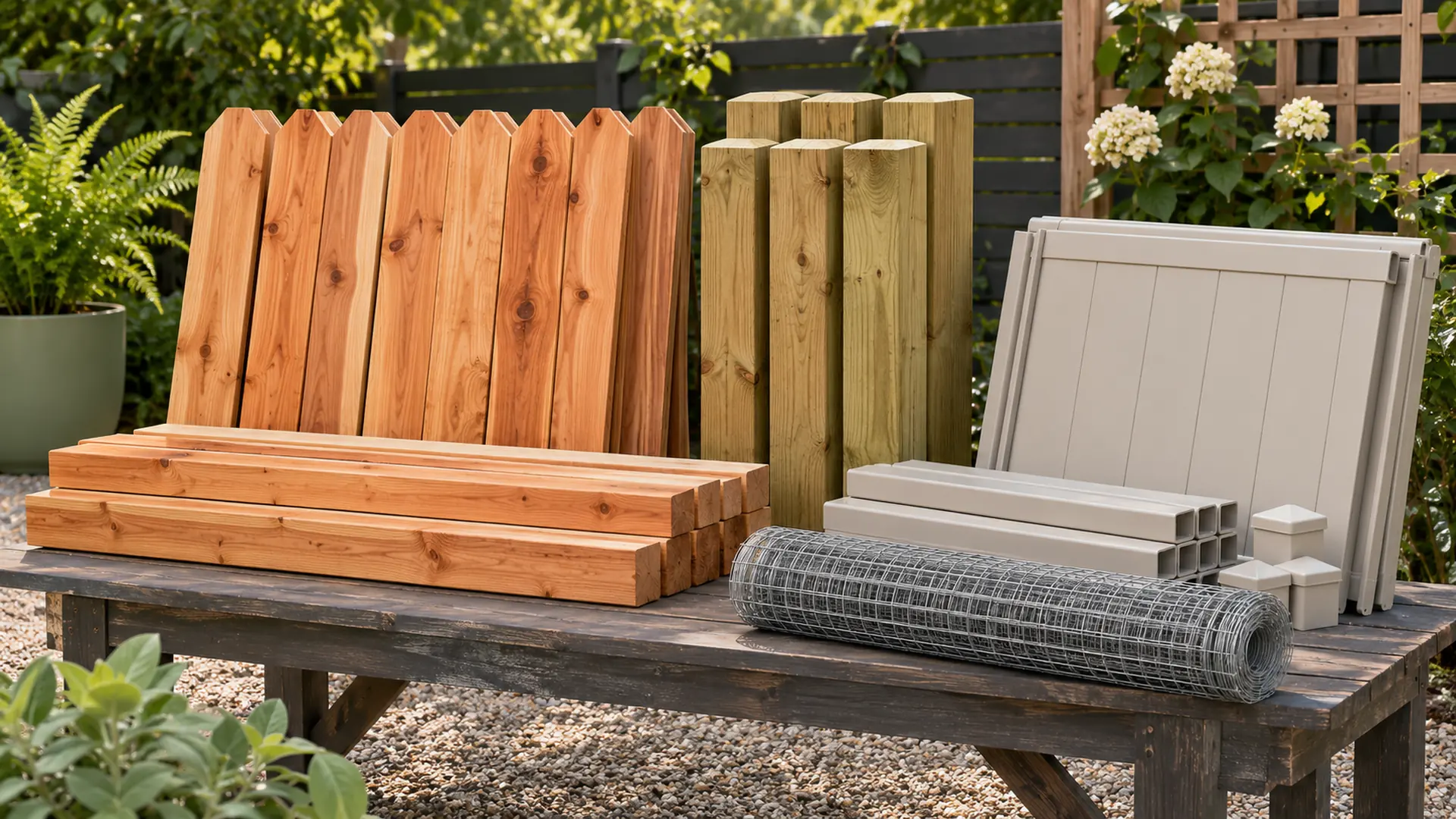
What the fence material calculator counts
The existing engine supports eleven styles, including wood picket or privacy, closeboard, panel systems, vinyl, composite, metal, chain link and agricultural wire options. It only shows inputs that apply to the selected assembly.
Measure the fence and choose the assembly
Your measurements need to match the assembly you have selected. Board width and gaps determine picket coverage, while closeboard needs the actual overlap between boards. If you’re using a proprietary panel or a different rail arrangement, the supplier’s dimensions and rail schedule take priority.
Fence height alone doesn’t establish the right rail count for every product, even when two finished fences look similar.
Posts, boards and rails formulas
A simple open run with S sections needs S + 1 posts. Rail positions equal sections × rails per section. Board quantities depend on usable coverage: a spaced board covers its width plus the chosen gap, while an overlapping board covers less than its full width.
The engine handles the selected style’s endpoint and overlap rules instead of treating every fence as a solid rectangle.
Worked example: a 48-foot wood fence
Take a 48-foot run divided into six 8-foot sections. With three rails per section, allow 7 posts and 18 rail positions. For 5.5-inch boards with no gap, the continuous coverage calculation gives 105 boards.
Adding 10% board waste gives 116 to order. Rail positions remain separate from purchased sticks because connections, cuts and stock lengths can change the purchase count.

Turn the list into an order
Your order depends on what’s included in each kit and how loose stock fits the openings. Complete panels may already contain rails and infill, so those components shouldn’t be bought twice. For loose rails, stock length and connection details matter because a short stick cannot fill a longer span without an approved splice.
Waste gives you spare purchasing quantity; it doesn’t make the installed fence longer.
Know what needs a separate layout
You can use the result for one straight, level run, then handle gates, corners and slopes with their own layout details. Optional footing quantities describe the dimensions you enter, rather than verifying a suitable foundation. Before you order, a comparison with the actual product’s pack contents helps catch missing posts, included rails or fittings that aren’t represented by an ordinary fence section.
Frequently Asked Questions
Does this calculate installation cost?
This page shows quantities. Use the cost calculator for dated price examples or your own supplier rates.
Can I use nominal board sizes?
Use actual dimensions for coverage and displacement. Nominal labels may differ from the piece you measure.
Does waste make the fence longer?
No. Waste covers purchasing losses, not extra installed fence length.
Sources & References
Method notes · Checked 10 November 2026
Published references
- Lowe’s: How to Build a Wood Fence. Published wood-fence construction example, including board measurements and assembly details. Its spacing and rail schedule are application-specific.
- Weatherables: Vinyl privacy fencing. Manufacturer product examples distinguish complete panel-kit contents from separately purchased posts. Verify the exact kit and dimensions.
- USDA NRCS: Fence conservation practice standard 382. The national standard directs users to local Field Office Technical Guide documents for actual planning, design and installation.
- Chain Link Fence Manufacturers Institute: Technical information. Industry technical guidance for chain-link applications. Quantity arithmetic does not verify wind resistance or structural member sizes.
Our calculation and planning assumptions
One straight, level run is modeled. Eleven assemblies use their own coverage rules. Waste is an ordering choice; complete kits do not need their included parts counted again.
Results are preliminary planning estimates. Confirm the actual fence system, local requirements and installation conditions before construction.