For your 6-foot fence, the buried-post estimate can be 24 or 36 inches, depending on the height fraction you use. Your installation requirements may specify something different. The standard depth of fence posts depends on the fence system, ground, exposure and local frost requirements, so you need to know exactly what a quoted depth includes before buying posts or digging.
Standard depth of fence posts: understanding the range
Your fence needs a depth that suits the actual installation. QUIKRETE’s post-setting guidance illustrates a buried length of roughly one-third to one-half of the above-ground post height, with a separate 6-inch gravel base. That gives you a useful planning range, but the instructions for your fence and the requirements at your property still control the installation.
For the table below, H means the post height above finished ground and E means the length buried in the ground. You can use the figures to compare conventional posts before applying any deeper local requirement. Your installation still needs a suitable specification.
| Above-ground height | H ÷ 3 buried depth | H ÷ 2 buried depth | Hole with 6 in below the post |
|---|---|---|---|
| 4 ft / 1219.2 mm | 16 in / 406.4 mm | 24 in / 609.6 mm | 22–30 in |
| 5 ft / 1524 mm | 20 in / 508 mm | 30 in / 762 mm | 26–36 in |
| 6 ft / 1828.8 mm | 24 in / 609.6 mm | 36 in / 914.4 mm | 30–42 in |
| 7 ft / 2133.6 mm | 28 in / 711.2 mm | 42 in / 1066.8 mm | 34–48 in |
For example, the recommended post-hole depth for a 4-foot fence cannot be determined from height alone. The table gives 16–24 inches of buried post, or 22–30 inches of excavation with that base arrangement. A deeper frost requirement or a product specification can override both figures. The same distinction applies when you ask how deep a 5-foot or 7-foot fence post should be.

Why does “one-third” sometimes give a different answer?
The denominator matters.
If you divide your visible height by three, you get E = H ÷ 3. But if one-third of the total post length is buried, E = (H + E) ÷ 3, which rearranges to E = H ÷ 2.
For a 6-foot visible post, those calculations give 2 feet and 3 feet underground respectively. QUIKRETE’s FAQ wording refers to overall post length, so don’t carry a fraction from one instruction into a formula with a different height reference.
Are 2 feet, 3 feet, 300 mm or 500 mm deep enough?
Your chosen depth needs to meet the requirements for the particular installation. You can use these comparisons to see where it falls within the height-based range, then check the applicable soil and loading requirements for your actual fence.
Is 2 feet deep enough for fence posts?
Two feet equals 24 inches or 609.6 mm. For a 6-foot above-ground fence, that’s the one-third-height estimate; for a 4-foot fence, it’s the one-half-height estimate. So your 24-inch buried length represents a different proportion of each fence.
You also need to distinguish a 24-inch hole from a 24-inch buried post. If the post rests on 6 inches of gravel inside that hole, only 18 inches of post sits below ground. Write down both measurements before comparing a contractor’s quote or an installation sheet.
Is 3 feet deep enough for fence posts?
Three feet gives 36 inches or 914.4 mm of buried post. That matches half the visible height of a 6-foot fence, but it can still be shallower than a local frost or foundation requirement. Your gate post also carries a different load when it supports a wide, heavy gate.
For a 7-foot fence, the half-height figure is 42 inches. Don’t assume that reaching a round number such as 3 feet finishes the sizing decision.
Is 300 mm deep enough for fence posts?
Three hundred millimetres is about 11.8 inches. It falls below even the one-third-height figure for a 4-foot fence, which is 406.4 mm. For your conventional 4-foot fence, that is less than the buried length in this preliminary comparison.
If you choose a proprietary surface-mounted fence, its foundation can be completely different. You need that system’s installation details before comparing it with a timber post placed in soil.
Is 500 mm deep enough for fence posts?
Five hundred millimetres is about 19.7 inches. It’s close to, but slightly below, the 508 mm one-third-height figure for a 5-foot fence. For a 6-foot fence, the corresponding figure is 609.6 mm.
If 500 mm describes the whole hole and includes a base beneath the post, the buried timber is shorter again. The metric measurements make this easy to miss when you are comparing a post sold in metres with advice written in feet.
How do frost, wind and ground change the estimate?
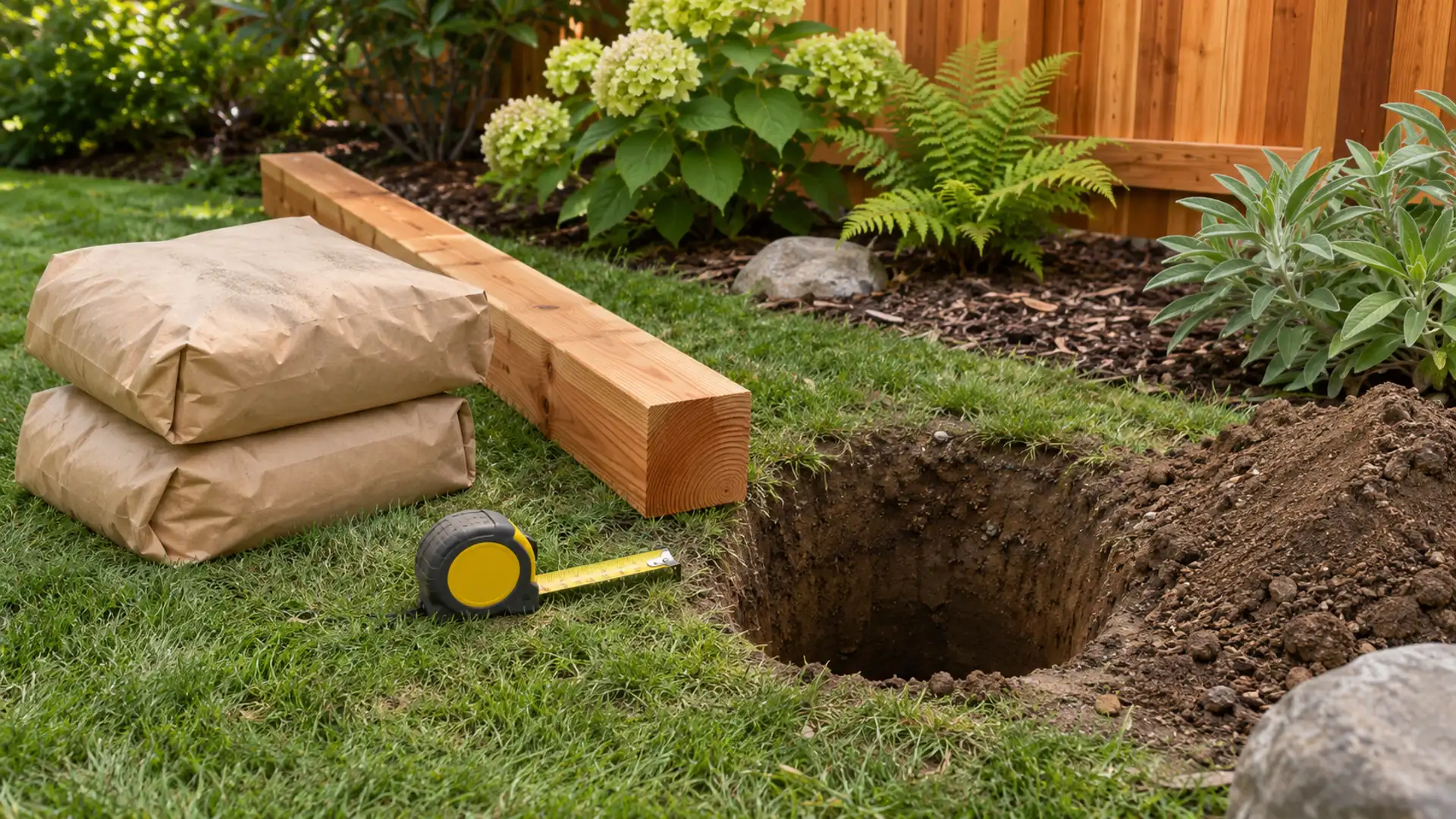
A deeper applicable frost reference can raise the depth above the height-based figure. In height-planning mode, the final planning depth is the greater of the structural starting depth and the numerical frost reference, with any explicit depth settings also respected. The structural method label stays tied to the original one-third or one-half choice.
For instance, a 72-inch fence with a 24-inch structural estimate and a 48-inch frost reference gives 48 inches of buried post. With 6 inches of gravel beneath it, the hole becomes 54 inches. The frost level and post bottom are both 48 inches below ground, while the hole bottom sits another 6 inches lower.
The National Weather Service frost page supplies regional frost information, not a guaranteed design depth for every property. Local requirements and site information are more useful than assigning a foundation from an average winter air temperature.
Your height plan starts with one-third for normal wind and firm ground. Exposed wind, loose ground or a gate/special-load post selects one-half once, even when several triggers apply. This is our preliminary budgeting policy; published guidance does not turn those broad descriptions into a calculated wind or soil resistance.
Until you select winter conditions or enter a known local value, frost is marked “Not assessed.” Extreme seasonal freezing uses an 80-inch planning reference and a prominent verification warning. That value is our generalized assumption, not a universal climatic standard; an entered local value replaces it. No automatic 6-inch frost margin is added.

How do post length, gravel and hole width fit together?
Your total post length is the above-ground length plus the buried-post length. Gravel beneath your post adds excavation depth while the timber length stays the same. For a post resting on the base, the relationships are L = H + E and D = E + G, where G is the base thickness.
A 72-inch visible post with 24 inches buried needs 96 inches of timber before any extra projection or cutting allowance. The separate 6-inch base makes a 30-inch hole. If your post extends through the gravel instead, use the matching placement setting so the quantities and drawing reflect that arrangement.
The hole diameter is another measurement. For conventional installations, approximately three times the post width is a published preliminary reference, rather than a footing capacity calculation. A nominal US 4×4 is commonly 3.5 inches square, so three times its actual width is 10.5 inches. The calculator’s practical 12-inch suggestion for that conventional post is a rounded planning size, not a statement that the timber measures 4 inches.
A user-entered diameter and a manufacturer’s required dimensions take precedence. Width is not automatically increased for wind or soft soil, because there is not a verified universal multiplier for those conditions.
A worked concrete and bag example
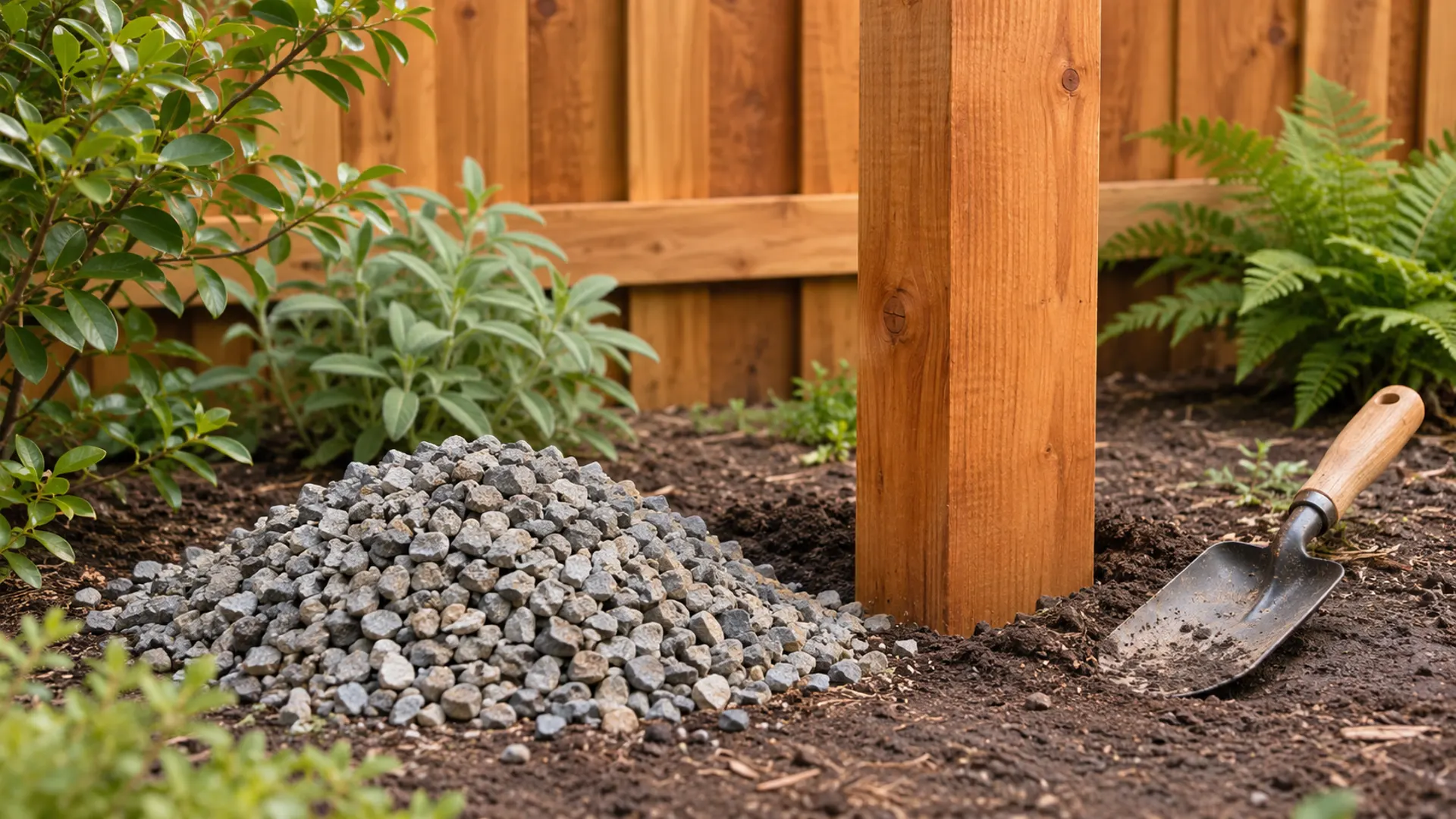
A round 12-inch hole around a 3.5-inch square post, with 24 inches of concrete fill, needs approximately 1.4007 cubic feet of concrete. The volume is [π × (12 ÷ 2)² − 3.5²] × 24 ÷ 1728. You subtract the part of your post occupying that concrete layer.
Adding 10% gives 1.5407 cubic feet. Using the published 80 lb reference yield of approximately 0.60 cubic feet per bag, round 1.5407 ÷ 0.60 up to 3 bags. Check the yield on the actual product you buy.
For several identical holes, total the concrete first and round the whole-job bag count once. If you round each hole separately, your shopping quantity can increase unnecessarily. Your gravel, unfilled top section and excavation shape change the volume, so measure these before relying on a fixed number of bags per post.
What should you check before digging?
Your fence plan needs a confirmed boundary, the correct finished ground level and the installation details for the chosen fence. A 6-foot panel plus a ground gap can put the post top above 6 feet, and the calculator’s height input must describe the measurement named beside that field. The “Check a post I have” mode separately subtracts the panel, gap and top projection from your existing post length.
Before US excavation, use 811’s utility-marking process, wait the required state-specific time and confirm the required responses. Outside the US, use the relevant local utility-location service. A low fence or a hand-dug hole still needs that check.
You should also confirm whether height limits, easements, pool-barrier rules or approvals affect the proposed line. For a slope, take measurements at the relevant posts rather than assuming the highest and lowest ground points share one finished level.
Which calculator starting point should you use?
Choose “Plan from fence height” when you know the finished height but have not bought posts. You’ll get the selected structural starting point, any numerical frost reference, the suggested hole diameter and the resulting material quantities. Fine-Tune lets you replace the base and other dimensions with the installation details you actually intend to use.
Choose “Check a post I have” when the available timber is fixed. For example, an 84-inch post with a 60-inch panel, a 2-inch ground gap and 2 inches above the panel leaves 20 inches underground. Changing the hole depth cannot create extra timber, so compare the remaining buried length with the depth your installation requires.
Choose “Use a known depth” when a local authority, installer or product sheet has already supplied the installation depth. Enter that measurement rather than trying to reproduce it by changing wind or ground categories. This keeps the source of your selected depth clear and makes the post-length and material calculations easier to check.
Frequently Asked Questions
Does an 8-foot post automatically suit a 6-foot fence?
It leaves 2 feet underground only if exactly 6 feet remain above ground. A ground gap, extra projection or deeper required burial can make that post too short.
Can I replace depth with extra concrete width?
There is no general swap that this calculator verifies. A wider hole changes your material quantity. You still need the appropriate design or installation specification to establish the required foundation resistance.
Does fast-setting mean ready for every load?
No. The fast-setting technical sheet gives a typical 20–40 minute setting time, but strength develops over time. Follow the purchased mix and fence instructions before attaching or loading the fence.
Sources & References
Research checked 10 November 2026. Primary links appear beside the facts they support above; each destination is linked once.
The tables and worked examples are independently calculated arithmetic, not reported field measurements. Published installation guidance has a stated application; local requirements and the actual product instructions take precedence.
The calculator’s wind/ground selection, winter categories and practical diameter rounding are our generalized preliminary planning assumptions. They are not engineered load checks or national frost standards.